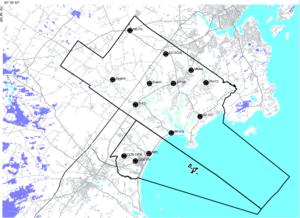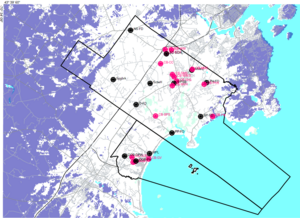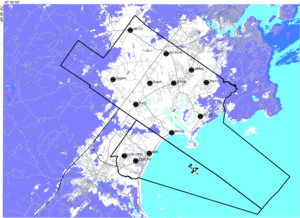
RCM uses RAPTR (Radio Analysis and Propagation Tool Repository). RAPTR propagation modeling is compatible with Telecommunications Industry Association (TIA) Telecommunications Systems Bulletin TSB-88 “Wireless Communications Systems – Performance in Noise and Interference Limited Situations – Recommended Methods for Technology-Independent Modeling, Simulation, and Verification.” RAPTR uses the Okumura-Hata-Davidson (OHD) model as described in TSB-88. Factors relating to environment and terrain combine to derive the total path loss value. RAPTR employs the Epstein-Peterson diffraction model in conjunction with the OHD model in a proprietary method to greatly enhance the path loss calculation. The diffraction calculations coupled with the environment database further increase the accuracy of the path loss calculation.
RAPTR uses a Tile Method for analyzing the propagation, a much more accurate method than the older radial method. Radial methods begin to lose resolution as the distance from the site increases as the distance increases between evaluation locations from radial to radial. The Tile Method uniformly predicts the coverage for a system by dividing the project area (i.e. City jurisdictional boundary area) into small areas called tiles. The size of the tiles used by RAPTR is three arc-seconds, approximately 300 feet per side. RAPTR models the propagation from a site to each tile in the project area. With the Tile method, the interaction of signals from different sites can be more accurately determined. This increases the accuracy of evaluating coverage for simulcast systems, voting systems, multisite networks, interference, and handoff (roaming).
The RAPTR path loss calculation methods are the result of evaluating over 189,000 different propagation paths as part of an extensive data collection effort performed by L3Harris over the past several years. These paths encompassed a variety of terrain and environmental features, ranging from over-water paths, to flat terrain in Florida, to mountainous areas such as Western Virginia, New Hampshire, and California. It also includes varying environmental conditions, ranging from highly urbanized areas to rural, open, and forested areas. As a result, the propagation model has been finely tuned.